Real Clients.

Real Change 

You don’t need more information. You need proof that your body can change, even if you’ve tried things before, feel exhausted by symptoms, or are scared that this is “just how life is now”.

Here are some recent stories from clients who were where you are now and what became possible once we worked directly with their nervous system.

Gareth: From constant body tingling and fear something was seriously wrong… to feeling calm, regulated and symptom-free in 6 weeks

Gareth came to me after months of increasingly intense nervous system symptoms that nobody could properly explain. He was working in a very high-stress job and noticed that whenever he finally stopped in the evenings or at weekends, his body would suddenly react.

He experienced:

full-body tingling sensations
painful pelvic floor cramping
hyper-focus on every bodily sensation
anxiety that something serious was wrong

He’d visited his GP several times because the symptoms felt so alarming, but each time he was told there was nothing medically wrong. Which almost made it worse. The symptoms were still happening, but nobody could tell him how to stop them.

By the time we started working together, Gareth’s nervous system was essentially stuck in a constant cycle of stress, hypervigilance and physical activation.

What we focused on first
We didn’t start by digging through trauma or analysing the past. We focused on helping his body feel safe enough to regulate.

The first signs of change
<pWithin the first month, Gareth started noticing measurable nervous system shifts. His Oura Ring data showed:

increased heart rate variability (HRV)
improved sleep quality
periods of restorative nervous system states during the day for the first time he could remember

Even more importantly, he felt the difference himself. The tingling sensations started reducing. His body felt calmer. He became less hyper-focused on symptoms. He even started using the techniques in taxis on the way to stressful work events because he could physically feel the impact they were having.

The result after 6 weeks
the body tingling had completely disappeared
the painful muscle spasms were gone
sleep had improved significantly
HRV markers had improved
he felt calmer, safer and more connected to his body.

Importantly, this happened during one of the busiest periods at work he’d experienced. His external stress hadn’t disappeared. His nervous system response to stress had changed


Kim: From spending every weekend recovering from work… to having the energy to actually live again

When Kim came to me, she’d already been diagnosed with chronic fatigue by her doctor. In one of her check-ins, she said:

“I’ve had a lifelong habit of multitasking and busyness… slowing down and focusing on one thing feels really hard.”

Instead of being offered a clear path forward, she was essentially told:

  • rest when you can
  • manage your energy carefully
  • this may just be how life is now

For Kim, chronic fatigue didn’t just mean feeling tired. It meant:

  • dragging herself through the work week
  • spending weekends recovering instead of actually living
  • feeling guilty that even simple plans with friends felt like too much

What we worked on together

We started by helping her nervous system understand that slowing down was safe, and that rest could be restorative instead of just “collapsing”.

Her initial practices focused on:

  • very gentle nervous system regulation techniques that didn’t spike her fatigue
  • short, structured rest periods that taught her body how to switch into recovery mode
  • reducing the constant multitasking that was keeping her system permanently “switched on”

What changed

Over the following weeks, Kim began to notice:

  • more consistent energy across the week, rather than crashing at the weekend
  • the ability to enjoy her time off instead of just recovering from work
  • less guilt around resting, because she understood what her nervous system was doing and how to support it

Bit by bit, her life started to expand again. Weekends were no longer only for recovery. She had capacity for the things that made her feel most like herself.

Key takeaway: When we work directly with the nervous system, “this is just how life is now” stops being the story. Even with long-term fatigue, small, targeted changes can free up real, usable energy.

Clare: From living in constant “fight or flight”… to trusting her body and feeling safe again

When Clare came to me, she described her body as “always on”.

She woke up tense, went to bed wired, and spent most of the day somewhere between anxious, exhausted and braced for the next thing to go wrong.

She’d tried to talk herself out of it. She’d read about stress, mindset and boundaries. But her body still felt like it was in permanent fight-or-flight.

For Clare, this looked like:

  • A tight, clenched body that never really relaxed
  • A racing mind and difficulty switching off
  • Feeling on edge in everyday situations that “shouldn’t” feel stressful
  • A deep fear that her body was going to fail her if she didn’t hold everything together

She knew a lot “in her head” about stress. What she didn’t have was a way to show her nervous system that it was actually safe.

What we worked on together

Instead of asking Clare to think differently about her stress, we focused on helping her body feel something different.

We started with:

  • Very short, body-based practices that felt safe and manageable
  • Simple ways to notice when her system was moving into fight-or-flight
  • Grounding techniques she could use in real time, in the middle of her actual day

The aim wasn’t to never feel stressed again. It was to teach her nervous system that it could move out of survival mode and back into regulation without her having to “force” it.

What started to change

Over the following weeks, Clare began to notice subtle but powerful shifts:

  • Her body didn’t go straight to maximum tension every time something went wrong
  • She could feel the early signs of activation and respond before she spiralled
  • Her baseline level of anxiety dropped, and “normal” days actually felt normal
  • She had more capacity for small stresses without them wiping her out

Bit by bit, her relationship with her body changed from “I don’t trust it” to “I understand what it’s doing and I know how to support it.”

The result

By the end of our work together, Clare described feeling:

  • Calmer and more grounded in her own body
  • More able to relax without fearing she would “crash”
  • Confident that she had practical tools she could use on good days and bad
  • Less controlled by her nervous system, and more in partnership with it

The external demands of her life hadn’t magically disappeared. But her body was no longer meeting every challenge as an emergency.

Key takeaway

Clare’s story shows that you don’t have to think your way out of stress. When you work directly with the nervous system, your body can learn that it’s safe to come out of fight-or-flight, even if you’ve felt “always on” for years.

Melanie: From freezing, blacking out and living in constant fear… to finally feeling safe in her body again

When Melanie came to me, her nervous system wasn’t just stressed. It was shutting down completely.

She was experiencing an extreme freeze response that would sometimes leave her slumped in a chair, barely conscious, with no memory of how long she’d been there or how she’d ended up in that state.

She’d been to the GP multiple times. Every test came back the same: nothing medically wrong.

Which left her trapped in a terrifying cycle of symptoms, with no understanding of what was actually happening in her body.

What was really happening

As we worked together, it became clear that Melanie’s nervous system had learned freeze as a survival response very early in life.

Growing up with an abusive alcoholic parent, her body had adapted by shutting down in moments of fear and overwhelm to keep her safe.

Years later, her nervous system was still using the same response, even when the danger was no longer there.

Melanie described it like this:

“When I felt anxious, I would quite literally slow down my breathing to a point where I almost fainted out in my armchair.”

And at night:

“I could wake up during the night and be locked in fear, so frozen I felt unable to move or even breathe.”

Her nervous system was stuck in prolonged survival mode.


What we focused on first

We didn’t begin with trauma processing. We started by teaching her body safety in very small, manageable ways.

The first stage focused on:

  • sending micro-signals of safety to her nervous system
  • mindfulness practices to strengthen conscious awareness
  • learning to recognise early signs of hypoarousal and freeze
  • building regulation skills before the nervous system fully shut down

The goal wasn’t to force her body out of freeze. It was to help her recognise what was happening early enough that she could interrupt the pattern safely.

Over time, Melanie began reconnecting with her body instead of fearing it.


The shift

One of the biggest breakthroughs was that Melanie finally understood what was happening to her.

For years, the symptoms had felt random and frightening. Now she could recognise:

  • when her nervous system was beginning to shut down
  • what triggered the freeze response
  • how to regulate before reaching collapse

That awareness changed everything. Instead of feeling trapped inside the symptoms, she started feeling capable of responding to them.


The result

Melanie shared:

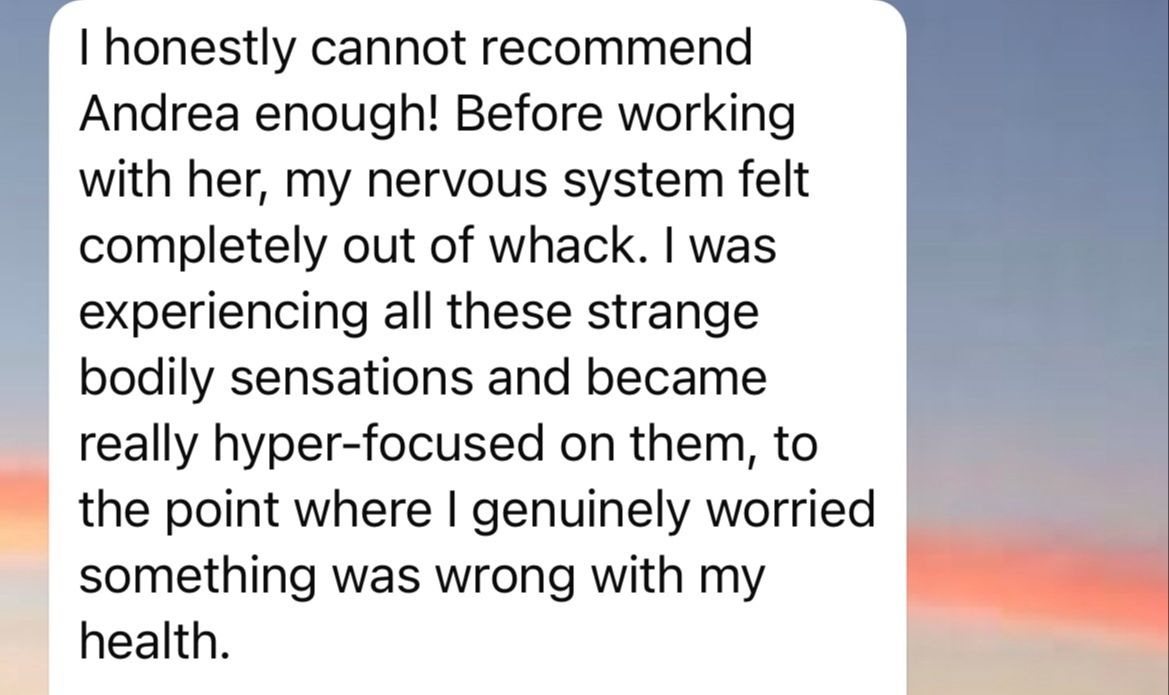
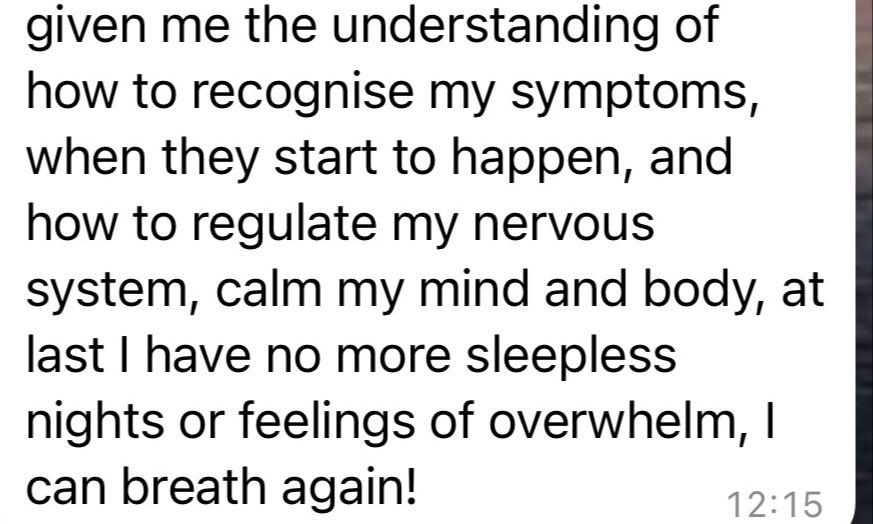
“Andrea has given me the understanding of how to recognise my symptoms when they start to happen, and how to regulate my nervous system, calm my mind and body.”

And most importantly:

“At last I have no more sleepless nights or feelings of overwhelm. I can breathe again.”

By the end of the programme:

  • the freeze episodes had significantly reduced
  • she no longer felt trapped in constant overwhelm
  • she could recognise and interrupt nervous system shutdown earlier
  • sleep improved
  • the nightly fear response reduced dramatically
  • she felt calmer, safer and more connected to her body

Key takeaway

Melanie’s symptoms weren’t random. They were survival responses her nervous system had learned years earlier and never fully switched off from. Once her body learned safety again, the freeze response stopped needing to take over in the same way.

Work with me